


_edited.png)
What Your Macros Actually Mean

(And Why Most People Get Them Wrong)
Everyone’s counting macros. But here’s the uncomfortable truth: most people are tracking them without understanding what they actually do — and that gap is costing them real results.
Whether you’ve been eating “lean” for months with nothing to show for it, or you’re stuck wondering why the scale won’t move, the answer is almost always the same: your macro ratio isn’t matched to your metabolism.
In this post, we’re breaking down exactly what macronutrients are, what each one does inside your body, and why a personalized approach — not a generic calculator — is the difference between results that last and frustration that doesn’t.
First: What Are Macros?
Macronutrients — or “macros” — are the three primary nutrients your body uses for energy and function. Every food you eat is made up of some combination of these three:
Macro | Calories per Gram | Primary Role |
Protein | 4 cal/g | Muscle repair & satiety |
Carbohydrates | 4 cal/g | Energy & performance |
Fat | 9 cal/g | Hormones, brain & satiety |
Here’s the key insight most people miss: it’s not just about how many calories you eat. It’s about the ratio of protein, carbs, and fat that makes up those calories — and that ratio should be built around your body, your metabolism, and your goal.
Protein: The Macro Most People Undereat
If there’s one macro that consistently separates people who get results from those who don’t, it’s protein. And in our experience coaching hundreds of clients, it’s the one most people are eating the least of.
What protein actually does:
• Builds and repairs muscle tissue after training
• Preserves existing muscle mass during a calorie deficit (critical for fat loss)
• Has the highest thermic effect of any macro — your body burns 20–30% of its calories just digesting it
• Keeps you fuller for longer, reducing the urge to snack or overeat
A practical target for most people is 0.7–1g of protein per pound of bodyweight per day. Most people we scan with our InBody machine are eating less than half that amount — and then wondering why they’re losing muscle instead of fat.
💡 Coach’s Note If fat loss is your goal, protein is non-negotiable. Eating in a calorie deficit without adequate protein doesn’t just burn fat — it burns muscle too. And less muscle means a slower metabolism, which makes everything harder over time. |

Carbohydrates: The Most Misunderstood Macro
Carbs have had a rough decade. Low-carb diets, keto, “carbs make you fat” — the misinformation has been loud. Here’s the reality:
Carbohydrates are not the enemy. Carbohydrates are fuel.
Your brain runs primarily on glucose (from carbs). Your muscles store glycogen (from carbs) to power your workouts. Carbs are your body’s preferred, most efficient energy source — and cutting them too low has real consequences.
What happens when you cut carbs too aggressively:
• Fatigue, brain fog, and low energy — especially during training
• Muscle loss, because the body breaks down muscle for glucose when carbs are too low
• Stalled fat loss, because a stressed, under-fueled metabolism adapts by holding on to fat
• Mood disruption and poor sleep, because serotonin production relies on carbohydrates
That said, not everyone needs the same amount of carbs. Someone who trains six days a week has completely different carbohydrate needs than someone who works a desk job and walks on weekends. This is why your carb intake should reflect your actual activity level and metabolism — not a blanket rule.
Dietary Fat: Don’t Cut It — Calibrate It
Dietary fat doesn’t make you fat. That’s a myth that has caused real harm — particularly among people who slashed fat from their diet and then couldn’t understand why they felt terrible, their hormones were off, and their results stalled.
What dietary fat actually does:
• Produces hormones — including testosterone and estrogen, which are critical for body composition
• Absorbs fat-soluble vitamins A, D, E, and K — without fat, these vitamins can’t be used by the body
• Supports brain function and cognitive performance
• Maintains satiety between meals, helping you stay on track without white-knuckling it
The goal isn’t the lowest possible fat intake. The goal is the right fat intake for your body and your archetype. Cut too low and your hormones suffer, your energy crashes, and your results plateau. Calibrate it correctly and everything works better.
The #1 Mistake: Using Someone Else’s Split
Here’s where most people go wrong: they find a macro split online, copy a friend’s plan, or use a generic app-generated ratio — and then wonder why it isn’t working.
The problem is simple. That split was built for someone else’s metabolism.
Two people can be the same height, the same weight, and have completely different body compositions, hormonal profiles, activity levels, and metabolic responses to food. A macro plan built for one of them can actively work against the other.
This is the core insight behind how we approach nutrition at Activ Fitness. Instead of giving every client the same template, we use InBody body composition scanning to understand what’s actually going on inside each person’s body — their muscle mass, fat mass, total body water, and basal metabolic rate — and then we match them to the right Macro Archetype.
The 5 Macro Archetypes: Personalized Nutrition at Activ Fitness
At Activ Nutrition, we don’t hand clients a generic plan. We match each person to one of five Macro Archetypes based on their InBody data, metabolic profile, training frequency, and goal. Here’s a summary of each:
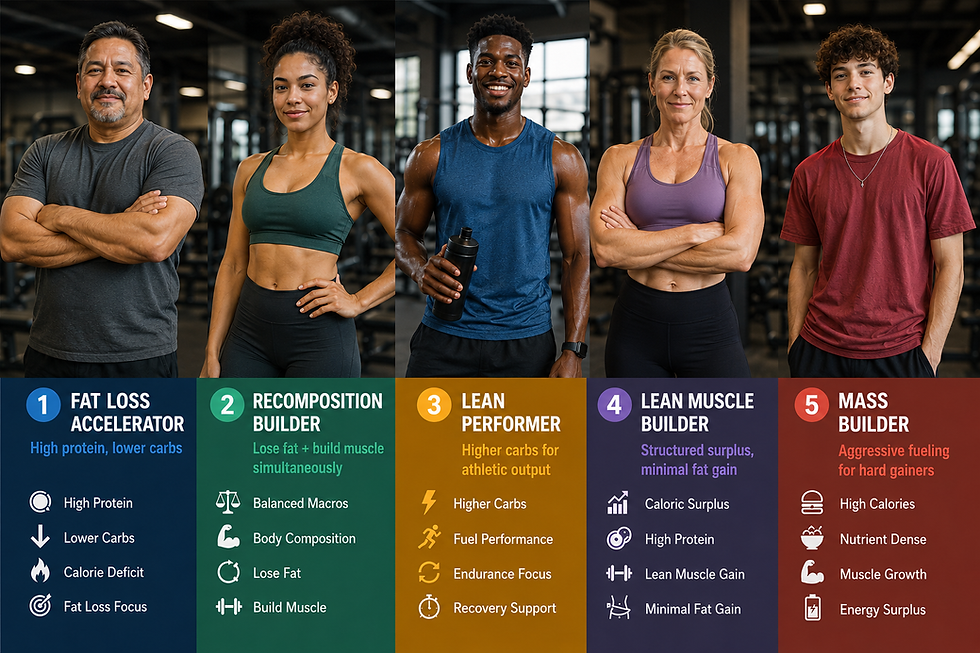
Your archetype is determined through a combination of your InBody scan results and a short metabolic profiling process that helps us understand how your body responds to different foods. The result is a macro split that’s calibrated to your metabolism — not borrowed from someone else’s.
What This Looks Like in Practice
Here’s a quick example of why personalization matters:
Client A is a 38-year-old woman who gains weight easily, feels sluggish after carb-heavy meals, and does mostly strength training. Her InBody scan shows higher body fat and lower muscle mass relative to her weight. She gets matched to the Fat Loss Accelerator — a high-protein, moderate-fat, lower-carb approach that works with her metabolism, not against it.
Client B is a 29-year-old man who trains six days a week, struggles to gain weight, and has high energy on carb-heavy days. His InBody scan shows high muscle mass and low body fat. He gets matched to the Mass Builder — a high-calorie, high-carb approach built to fuel his training and support muscle growth.
Same gym. Same equipment. Completely different nutrition plans — because they have completely different metabolisms and goals.
The Bottom Line
Macros are not complicated once you understand what each one does. The challenge isn’t the math — it’s making sure the math is built around the right starting point: your body.
Protein builds and protects your muscle. Carbs fuel your energy and performance. Fat supports your hormones and keeps you satiated. The ratio of those three — your macro split — should reflect your metabolism, your activity, and your goal. Not a template.
That’s the difference between nutrition that works for a few weeks and nutrition that becomes a lifestyle.
📍 Ready to find out your Macro Archetype? We start with your InBody body composition scan — real data about your muscle, fat, and metabolism. Then we build your plan from there. No guessing. No templates. Text us at 704-807-7838 or visit Activ Fitness at Huntersville Square to book your scan. |
Activ Fitness (AV8 Fitness LLC) | 14212 Statesville Rd, Huntersville Square, Huntersville, NC 28078
activfitnesshuntersville.com | Activ Nutrition | 704-807-7838
_edited.png)

Dit artikel behandelt het thema op een evenwichtige en goed gedocumenteerde manier. Ik waardeerde hoe ook de minder bekende aspecten van het onderwerp worden behandeld. Ik heb de link naar een paar vrienden gestuurd die geïnteresseerd zijn in dit onderwerp. Het is niet eenvoudig om zo goed gedocumenteerde artikelen over dit onderwerp te vinden.